
A Family Friendly Look at the underside of society
(Americans)…are a race of convicts, and ought to be thankful for anything we allow them short of hanging. -Samuel Johnson, 1769 (Boswells Johnson, Vol. II, pg. 312; Penny Cyclopaedia, XXV. 138)
(Americans)…are a race of convicts, and ought to be thankful for anything we allow them short of hanging.-Samuel Johnson, 1769 (Boswells Johnson, Vol. II, pg. 312; Penny Cyclopaedia, XXV. 138)
In the collection Memoirs and Correspondence of Thomas Jefferson, one of the letters therein, written in 1785 from France by Jefferson, will reveal an interesting belief he had about English criminals sent to America. He writes: “…the malefactors sent to America were not sufficient in number to merit enumeration (and) it was at a later period of their history that the practice began. I do not think the whole number would amount to 2,000 and, being principally men eaten up with disease, they married seldom and propagated little. I do not suppose that themselves and their descendants at present number 4,ooo, which is little more than one thousandth part of the whole inhabitants.”This statement, by one of the preeminent founding fathers is of course undeniably true. After all, our founding fathers had only our best interest at heart and to think they might lie to put on a good face to another nation is as unpatriotic as claiming peach pie more American than apple!
But do we see any reason to doubt his assessment? In short, yes.
The purpose of this and future articles will look at the aspects of the ‘scoundrels’ who came to America. Why they came, how the survived, their place in history, the arts, entertainment and the lingering effects into today.
As to Jefferson’s comment about the exact number of transported criminals sent to America, were they really so few malefactors as to not even mention? Hardly. As Anthony Vaver points out in his well researched and documented book Bound with an Iron Chain, the amount of transported criminals from England to America between 1718 and 1775 was closer to 50,000 than Jefferson’s estimate of 2,000. Of these, approximately 18,600 from London, 16,000 from Ireland, 5,000 from Wales, 700 from Scotland and the rest, some 30,000 from all over England proper. Further evidence suggests that 75% of all immigrants coming into the American Colonies in the 18th century were either slave, indentured servants or transported criminals. Jefferson surely knew this to be true, for after all it was common and accepted knowledge .
Benjamin Franklin, another of our well-known founding fathers, will pen an ‘op-ed’ to the Pennsylvania Gazette in may of 1751, an article entitled ‘Felons and Rattlesnakes’ addressing this very issue of England transporting her prisoners to the Colonies. In the article he laments the decision of Great Britain to fill America (referred to as “her child”), with the dregs of society because it was a lucrative trade. Never mind that “…these Thieves and Villains introduc’d among us, spoil the Morals of Youth in the Neighbourhoods that entertain them, and perpetrate many horrid Crimes: But let not private Interests obstruct publick Utility. Our Mother knows what is best for us. What is a little Housebreaking, Shoplifting, or Highway Robbing; what is a Son now and then corrupted and hang’d, a Daughter debauch’d and pox’d, a Wife stabb’d, a Husband’s Throat cut, or a Child’s Brains beat out with an Axe, compar’d with this “Improvement and WELL PEOPLING of the Colonies!” (Pennsylvania Gazette, 9 May, 1751).
In truth, England was overrun by criminals-both those who chose the life and the poor who were given no choice but thieve or die. As the population of the cities grew, the need for land expanded, so where once the countryside could help support the laborers by farming, hunting and fishing, the city had swallowed up the lands and resources, forcing more and more people into the cities looking for what once was freely provided. Work was scarce, food even more limited. The desperate poor often had no choice but to turn to thievery just for basic survival, leading to a crime epidemic the culture of the time was ill equipped to deal with.
In 1731, Daniel Defoe will pen and publish his work entitled An Effectual Scheme for the Immediate Preventing of Street Robberies whereby he bemoaned about the violence and plunder no longer being confined to the countryside with highwaymen the biggest threat but rather ‘…the streets of the city are now the places of danger, men are knocked down and robb’d, nay, sometimes murdered at their own doors, and in passing and reposing but from house to house or shop to shop.’ It was obvious that a workable solution had to be found.
To the culture of the day, the idea of long-term incarceration smacked of ‘cruel and unusual punishment’. Generally prisons were crowded, filthy and disease ridden. It was also thought by some to have a detrimental effect on the petty thief, because throwing a petty thief in with the ‘hardened’ criminals could very possibly lead them to becoming ‘professionals’ just by the close proximity of the two entities. Plus, quick punishment was desired as to decrease the cost to the government. To understand this attitude, it first must be understood that the justice system of this time was considerably different from ours of today. The government had very little interest or ability in way of ‘rehabilitation’ and in truth very little monies were spent on food, clothing and housing of criminals. The penal code was very short and-to our minds-severe. Whipping, branding and public shaming were the first order of business, with execution a close second. Often a ‘two strikes and you’re dead’ policy was the norm rather than the exception. What we would consider ‘petty crimes’-such as the theft of two handkerchiefs-would carry a mandatory sentence of execution.
It was overcrowded prisons that would lead to the problem of excessive executions and eventually the solution known as the Transportation Act. So many executions were being carried out in the early part of the 18th century that many jurists concluded that instead of deterring crime, it had become a public spectacle. Hanging days became a grand event, with London placing on her books an edict that workers were allowed 9 ‘execution day’ excuses to miss work.They even took their families to see the display, often making these execution days not days of mourning and consideration of the law, but rather a fair-like atmosphere was created, complete with speeches, sermonizing, histories of the crimes and of those being hanged. There were games and gaming, ‘Punch’ shows, races and other activities before the ‘grand event’. At times, even some of those scheduled for the gallows joined in, laughing and joking all the way up the steps to the hangman’s noose.
Thus, in 1718 the English Parliament set ‘The Act for the Further Preventing Robbery, Burglary and other Felonies, and for the More Effectual Transportation of Felons’ into the statute book. In essence, it legitimized the transportation of criminals as a direct sentence for felonies that did not warrant the death sentence, a seven year forced indentureship for petty and grand larceny and other such non capital offenses deemed to be so by a judge. Capitol offenses, if pardoned by the Crown, increased the number of years from seven to fourteen. It also gave the Courts leeway to charge for a lesser crime so that instead of transportation, branding on the thumb and public whippings would suffice. While this seems a kinder, more humane gesture, the sad truth was that as time went on more and more women were given the reduced punishments rather than being transported. The simple reason was that women were not worth as much, nor wanted as much, as the men were.
This is not to say that these were the first criminals to be transported and sold as indentured servants, but the Transportation Act did speed up the amount of immigrants coming of their own free will. As stated above, between 1718-1755 some 75% of immigrants coming to America came by force, with transported criminals being second only to African slaves. Still, as pointed out by Peter Coldham in the Complete Book of Emigrants, 1607-1776 that prior to the Transportation Act, it has been estimated that the 17th Century saw only about a third of all immigrants arriving in a state of freedom.
England did not seem to care what happened to these convicts once they left England proper. All she seemed concerned with was that they were gone and wouldn’t return-under penalty of death-until their time was served. Simply put, England kept an ‘out of site, out of mind’ approach. In addition, their term of ‘indentureship’ did not start at conviction, sentencing or even while still on English soil. It did not start until they were in the Colonies proper, on shore where a government agent verified that they had arrived, whether dead or alive it mattered not. Just as long as they could be accounted for, then their time started. It should be noted here that the idea of ‘transported criminals’ was not to send them to a ‘penal colony’ such as Australia’s ‘Botony Bay’ but instead these people were brought to the Americas where they were to be sold at auction for their indenture time.
Oddly enough,England herself did not see the profit in the sale of these indentureship, for in truth she only cared that they were gone and she no longer had the care or trouble of them. Instead it would become a very profitable venture for some. On July 19, 1718 Johnathon Forward was awarded the contract for transport at the rate of £3 for any convict leaving from London and £5 for any prisoner leaving from any other place in England. He did this as a flat rate, while he himself covered the cost for food on the journey and transportation to the harbor, as well as supplying his own chains! besides the contract payment, he also kept the profits from the sale of the prisoners. His total cost for the first group of prisoners was £375 total. He estimated a return of some £2,700 pounds for the sale of the indentured servant contracts plus an agreement to return with a cargo of tobacco to be sold at market in London.
With everything in place, in the summer of 1718 the first ship of ’His Majesty’s Seven-Year Passengers’, as they would become commonly known, left England, headed for the markets of Virginia and Maryland. One hundred thirty-four convict crowded into the hold of the slave ship Dolphin, owned by Gilbert Powlson. The ‘Transportation Act’ had begun, and would continue uninterrupted until 1776 when the newly emerging United Stated of America would finally say ‘No More’.
Although difficulties did arise with the Transportation Act, the Crown took great troubles to ensure that those that were sentenced to be deported were removed from the kingdom as promptly as ships came available. Conditions aboard a transport ship were harsh; goal fever racked each ship as the convicts, sometimes shackled, were packed in overcrowded and unsanitary conditions. Treatment of convicts on board the ships ranged from liberality to harsh brutality depending on the officers in charge. James Revel, who was transported in April of 1771 to serve for fourteen years, penned his ode, The Poor Unhappy Transported Felons Sorrowful Account of Fourteen Years’ Transportation at Virginia in America, and described his crossing with these words: The Captain and the sailors us’d us well, But kept us nude lest we should rebel. We were in number about threescore, A wicked lousy crew as e’er went o’er. Five of our number in the passage died, Which soon was thrown into the ocean wide.
When they arrived, as all future Transported Criminals would be, they were cleaned up and notices were sent out, for the indentureships were often sold at auction. And while an average unskilled male slave in good condition could command up to £35, an unskilled transported convict would only average £12.84 pounds sterling. If they had a skill or a trade, up to £25. Taller criminals, thought to be more productive, commanded up to 20% higher, teenagers 20% lower. If a convict had been sentenced for simple theft, they generally went for a higher price than someone convicted of a more heinous crime such as arson. Often, however the aged, lame, weak and many children were just given away to whomever would take them or simply turned loose with no resources.
While most were sold as common field hands, if they showed aptitude or had some skill, they would be used in the common trades of the time-blacksmith, coopers, peruke makers to name a few. Unskilled persons could also be used as chimney sweeps, fishermen, sailors and soldiers. If a criminal was educated and could read and write, he might even be indentured into the role of teacher. George Washington was taught reading, writing and accounts by a transported convict, purchased by his father for that very reason.
Runaways were widespread among these indentured convicts, generally within the first 6 months, with runaways rare after their second year of indentureship. Those who did run were often quickly captured as the population was not large enough for someone to easily hide in. Those who were caught were usually taken back, publicly whipped and often time would be added to their indentureship. At times they would be ‘collared’ by having an iron ring-called a ‘pothook’ placed around their neck and riveted in place. Execution was the punishment for someone who helped a convict so ‘collared’ remove it without permission.
As the 18th Century moved along and the need for workers both skilled and unskilled spread out from the seaside and into the west, many convicts were sold as ‘lots’ by ‘Soul Drivers’. These men would purchase them in groups, line them up and head out into the countryside, selling as they went.
It is to be noted tho that the ultimate purpose was to turn a quick profit, so if a criminal being transported had the money-and some did-they could easily make a bargain with the captain of the vessel to pay the expected amount they would fetch on the block. As soon as the captain made his report to the official verifying that the convict had landed-thereby guaranteeing him his ‘transportation’ fee upon returning to England, he would simply let the convict go free. England truly did not care, as long as they were not IN England.
One of the reasons often sited by the government as to why these prisoners should be so transported was that they could, while serving out their sentences be given valuable experience and skills, thereby making something of themselves. Because they were considered the same as ‘indentured servants’ they were eligible for ‘Freedom Dues’ at the end of their contract. Each colony determined her own ‘Freedom Dues’ which usually consisted of a lot of land, seed, tools and money. Virginia, for instance, gave to each male completing service 1 musket, 10 bushels of corn and 30 shillings (or items of equal value). Women were given 15 bushels of corn and 40 shillings. This was given to both criminal indentureship (by the state) or anyone signing into indentureship by their employer. Unfortunately, Virginia passed a law in 1753 stopping the requirement for giving the convicts ‘freedom dues’.
But even without these ‘Freedom Dues’, most convicts were ill equipped to handle the work (often simply plantation field work) without ever learning a trade. As such, it is estimated that at the end of their service, 1 in 10 became planters, 1 in 10 artisans and 8 in 10 transient, setting up America’s own criminal element.
And what was the result of this first ship of ‘officially licensed’ criminals? It did not end well. What Forward did not know when he gave the first ship assignment to Powlson, was that Powlson himself was wanted in Maryland for past debts, so when the Dolphin lands in Annapolis, not only had 7 of the convicts died in transport, but Powlson was clapped in irons for debt, some £2,ooo of assets were frozen and the Dolphin herself after unloading sank in the harbor. This misfortune, however, did not stop Forward, as he would continue to hold the contract to transport prisoners to the colonies until he retired a very wealthy man in 1739. It was reported in the Calendar of Treasury Books and Papers, Vol. 4, 1739-1741 published by Her Majesty’s Stationery Office, London that ‘Andrew Reid of London, merchant, loco Jonathan Forward, and the contract to be made with him for that purpose is to be for 3 years certain.’ What is even MORE certain is the lucrative trade to be made in transporting and selling off these criminals in the colonies.
Thus we leave our discourse with one final thought; while many of us can point with pride to the knowledge that our ‘forefathers’ came to America in the 18th century, perhaps now knowing that fully 75% arrived in chains makes us pause and ask:
Do we truly wish to look at just how OUR ancestors arrived?
Bibliography
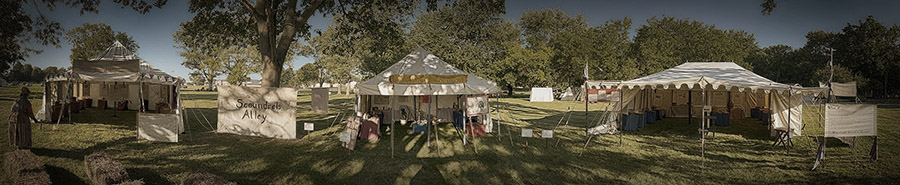
-‘Scoundrel’s Alley’ is the collaboration of Faire Wynds Entertainments and Parson John Living History. The ‘Scholarly Scoundrel’ is Eric Paul Scites (1962-2023)